

The Dialectics of Age
This website is here to support both young people and the young person in all of us to not lose our fresh creative spark as it moves into that phase of life generally called adulthood.
Dialectics of Age is a way of looking at age difference that helps to bring people of all ages back to the flow of our curious, innocent, and exuberant child-youthful self, as it is able to survive into adulthood. Too often, as the days of childhood wonder fade, the demands of the jobs, money, and complicated relationships overshadow this inner-sense that we had in our earlier years. It is not that the complexities of life are bad as these are the stuff of growth and developing healthy maturity. However, because we tend to compartmentalize age, the qualities of childlike or youthful wonder tend to get lost to the narrowed scope of adulthood.
As is generally understood, “age” refers to various stages of growth, from childhood to old age. When we become a teenager and into adulthood, the strong impressions we felt as children tend to fade.
But this does not have to be true as the child part of ourselves is still there. We may know this to some degree and this is not saying anything new, but it deserves to be said.
This website seeks to focus on this relationship between youth and adulthood, both in a person and in the society in general. Specifically, the role of youth both in a person and in the culture has a lot to do with “staying young”, retaining the qualities of youth, and keeping things fresh, where curiosity does not become stale, or new inspirations are not crowded out by old habits.

Take this image of a Douglas Fir tree in the yard where I live, for example. Each spring, new sprigs grow out from the end of it’s branches. This is its fresh, tender, vulnerable, and vibrant part of itself that reaches out with great delight into sunshine. We could say is the child self of this tree that takes the leading edge of its growth with the warming of each new year. Here is the youngest and newest part of the tree that is many years old. For people, we tend to think of our childhood self as being inside of us, and in our past. And yet, “childhood” or “youthhood” rather, like these soft light green sprigs, is that part of us that is on the edge of new growth, seeing things as if anew. Rather than it just being like our “inner child”, it is something that is there on the surface, where insecurity might be found as well as feelings of great inspiration.
This is the quality of youth, that, as this tree illustrates, is vital to the health of a tree. For people, these qualities come into play when we are learning new things, for example, but there is more to this. The retention of youthful qualities of creative thought, fresh feelings, awe inspired curiosity is so profoundly valuable. Indeed, to retain youthful qualities into adulthood is not only just a wonderful thing, it is key to keeping our society fresh and vital.
Age difference and the dynamics that exist between stages of growth are one of the most fundamental engines by which disfunction within our society is kept going, generation after generation. It is easy to see how a child who is born without racial prejudice becomes racist from the values within their family. A child who is traumatized from physical abuse, for example, may develop ways of coping that are harmful to others, such as being abusive themselves, or engaging in criminal activity.
A child is born innocent. This statement is key to our discussion here. Not all will agree with this, but based on the hard wiring of a healthy newborn, it is clear that they come into this world seeking to connect, to explore, to feel pleasure, and to delight in the wonders that are discovered. They don’t seem to naturally want to hate people of a different race, or make fun of people who are different from them. This is learned, and learned in a way that overrides their ingrown instincts. Racism, for example, is learned behavior that imposes itself on the young, and the opportunities to overcome the racism of prior generations that is available with each newborn is tragically lost. Indeed, this is no accident as we shall explore for there are certain deeply entrenched systems that guard society against the threats of each new, unsocialized generation.
Dialectic Theory
The word “dialectic” has generally two different meanings. The most common has to do with how people engage in debate with each other and there is a whole history of this term that goes back to Socrates. But about two centuries ago, the German philosopher Hegel used this term to understand the general dynamics of tension between two things that results in change. This is an idea that has been helpful in understanding how social progress occurs in the face of injustice, such as with how Marx and Engels used this theory to help understand the dynamics of class struggle.
The broad concept of dialectics goes like this.
- Thesis; You have a given condition where there is an already established imbalance of power. (Let us use the example of how in today’s world, there is a class of super super super rich people who, along with their corporations, wield tremendous power and influence in the world and along with this, there is class struggle, poverty, lack of basic resources for the majority of the population.)
- Antithesis; The people who get the short hand of the stick in this relationship become AWARE of this condition, and open their eyes to how they are being exploited for the gains of the people in power. (We might see that this new wave of democratic socialism is a voice which is increasingly showing how this economic disparity is out of control.)
- Synthesis; As a result of this awareness, action is taken whereby change occurs, resulting in a healthier and less imbalanced relationship.
This is one model of understanding a general way in which social change occurs.
Rarely will those who experience privilege, voluntarily stand down to lessen their status for the benefit of those who are less privileged. Dialectics refers to the phenomenon of how tension between a given condition in the face of an alternative view point is the pressure from which improvements come about.
Youth is a natural resource that can be exploited by the older generation, whether it be parents, teachers or social systems in general, at the expense of youth and benefit for the adults. This concept is complex, difficult to explain, largely invisible, and yet is the engine of the perpetuation of social ills at its most fundamental level.
The Dialectics of Sex (Gender)
A fantastic example of this that has occurred largely in the last 50 years has been the feminist movement, where women began to wake up in the early 70’s to see just how the system was rigged against them in favor of men. So over the last half century, women have make incredible strides in righting this imbalance. Ruth Bader Ginsberg is a shining example of this in how she helped to carve into a national legal standard the precedent of the equal rights for women. Note that it was not men in the early 70’s who, suddenly had compassion for women and said, we want to make this more fair for you. No, it took many many waves of activism before things began to change in a real way. Of course, this is still a work in progress.
A Dialectics of Age
I believe that understanding the tensions between age difference that exist both in society and within the individual is one of the great sources of healthy growth.
Take for example the history of childhood, which according to a massive study into this subject concluded that this history “is a nightmare we barely begun to wake up from” (reference). Indeed, in this Chicago study many years ago, they found that it was the phenomenon of how an adult was able to see in their child the possibility that that child could be treated more kindly, with greater compassion than that parent was raised with. This is called the psychogenic theory of social change, and, this group concluded, this phenomenon constitutes the greatest engine of social change as new generations were being raised with less trauma and less continued abuse towards the next generations.
This is one slice of a complex phenomenon of Age Dialectics.
I am a psychotherapist and basically, the bottom line of the work I do in seeing clients who come to me for therapy, is that we are working to help them come back into alignment with their deeper, truer self, which they had when they were younger, but they became increasingly alienated from this due to trauma, abuse, or the forces of socialization that naturally come with growing in this world.
Another angle is with regards to youth and children’s rights. This is a topic that rarely gets much traction because those who are the objects of exploitation soon out grow their status and enjoy the fruits of the class of adults.
I am so very very excited about what is happening with the latest wave of Student Strikes for Climate Change that is sweeping Europe and soon the US. This is a youth movement which is being spurred on by the exploitation of a dominant capitalist class in power who are spending their children’s inheritance of earth’s resources. This is a youth justice issue, as much as it is an issue of humanity’s very survival.
But the key here is that it is the young people who are not numbed to this issue, because they, like Greta Thunberg of Sweden, can’t help but see that this is the biggest issue that humanity is facing and yet the powers that be are completely unable to attend to it in a real way.
This is why it is exciting to see Alexandra Ocasio-Cortez come into the House of Representatives, though I know she is controversial, but it is by virtue of her youthfulness (she is the youngest person ever to be elected to Congress) that she is bringing in novel, fresh, not very complicated views of just how rotten this system has become.
So there are political dimensions to all this, as well as, and really more importantly how this relates to each of us on a personal basis.
How is it that we can grow into adulthood and not loose the creative spark of our youth?
Maturity is Not Bad
This is not so easy to put into words because it is not a black and white problem. For example, to mature is a wonderful process, like any fruit on the tree. As I mature, I am becoming more settled into myself, and able to be more present and giving to others. However, when I “matured” into adulthood (which took awhile and still is a work in progress, Ha!), I often lost sight of my inner guidance, that creative imagination and playful taunting of life’s possibilities that came so easily to me when when I was young.
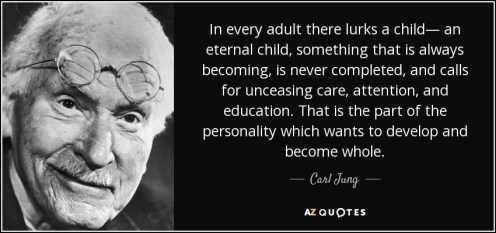
Another example of how this isn’t a black and white issue is that sometimes people just want to stay young and this can be a problem such as what has been called the Peter Pan Syndrome, where a person just won’t grow up and hence all sorts of problems result. I know this too well and have had a hard time being mature with my finances, as it really is one of my weakest links.
With regards to age, like where we are in our development, there are various forces at work within us that influence how we behave, how we think and this website is here to help flesh out what is all going on here with this “adulthood” ordeal. Because so often people stop growing in really important ways when they reach so called adulthood.
Dan’s Story
Today is May 17, 2018 and it was 40 years ago when I graduated from High School. I would like to share some of this story here, of what happened in that year, because I hope it can bring some inspiration to others.
Student Activism; Forty Years Ago and Today
You might have had the good fortune to hear Emma Gonzalez’s fiery speech to the media about guns and politics shortly after 17 of her fellow students were shot and killed at the Parkland High School in Florida. I, like many other people, were incredibly moved by the passion, the clarity and the power of her voice to call out the gun industry, as represented by the NRA, and the irony of a mature young people calling “BS” on the governing body of this country, who, as the gun violence epidemic rages, slip into deeper negligence and a corporate money soaked stupor.
When I was a senior at Northampton High School in western Mass 40 years ago, like Emma G. though on a much smaller scale, I also found my voice. The Student Outlook was a newspaper that my friend Lisa and I hand typed, printed and distributed at our school. It would have gone relatively unnoticed had it not been for how the principal told us we couldn’t distribute the paper on school grounds. When the ACLU got wind of this from local press coverage (thanks to Stanley Moulton of the Daily Hampshire Gazette), they represented us in court where a harsh distribution policy drawn up by the school board was deemed unconstitutional and our First Amendment right to free expression was upheld.
For a mere blip on the screen of history, we had that rare and valuable experience of being young people whose voices touched a blind spot, an uncomfortable nerve in the adult system of leadership. As Herb Leader wrote in an editorial to the Gazette about our paper, quoting Wilhelm Reich, “The principle weapon in the arsenal of (social) freedom is each new generation’s tremendous urge to be free.” Yes, it was the freedom to address hard issues that drove us to publish. We wrote about many things in the five issues of the paper, some that shed a critical light on this system of education such as the downside of grades, the problem of suspension as a discipline method, and the shadow side of the tracking or level system. We wrote about homosexuality, military recruitment in the schools, youth rights, the dangers of nuclear power, and teen suicide. We didn’t solicit a teacher to screen the articles, as was the procedure for the official school newspaper, rather these were our raw voices; unfiltered, messy, generally unpopular, awkward, passionate, BS detecting.
We who were apart of The Student Outlook I think can feel proud of what we did, not only because of how we successfully were able to prevent the school board from implementing a draconian distribution policy (rather than the one that was ultimately adopted that was not perfect but passed the First Amendment litmus test) but also, in direct response to the uproar that was generated by our article on birth control, the school board formed a diverse working committee to develop a health curriculum which was implemented at the school four years later. Like we wrote, “Students can make a difference because students HAVE made a difference.”
Students of Today
Though the Student Outlook has long since been forgotten, I have deliberately worked hard over these years to cultivate what I feel is my authentic voice and an out-of-the-box critical thinking ability that is connected to the spark of my on-going youthful self. I believe it is possible to sustain into our adulthoods the capacity for untethered imaginations and an aliveness of curiosity and of seeing the world with fresh eyes that is the very fuel of social change.
Students of today, may your words reach out to the Betsy DeVosses of this threatened educational system who are intent on making your youthhood just one more commodity in the long list of earth’s precious resources to exploit for the profit of the few at the top.
In one sense, the amazing March For Our Lives mass mobilizations and the Student Climate Strikes that have mobilized millions around the globe, these are movements that come specifically because young people are not quite bogged down by the burdens of adulthood to where they are expressing some really basic truths, like the importance of the survival of our planet. Here it is the youth voice, the unfiltered sensibility that comes from a less socialized, less molded, more innocent child and youth consciousness, like Emma Gonzales and Greta Thunberg, that awakens that sense of clarity in all of us and pushes society ever so slightly but deliberately towards a greater sense of health and well-being. To any student who is reading this who is contemplating speaking up, know that your voice is more valuable than you can imagine, especially if you can find the means to amplify your voice. Don’t be shy or embarrassed about your presentation, for the unpolished quality of your script is part of the gift. Tap into that wellspring that makes you feel like you are spreading your wings. As we quoted in our final issue of the Student Outlook from A. S. Neil, author of the groundbreaking book on alternative education, Summerhill, “New generations must be given the change to grow in freedom. The bestowal of freedom is the bestowal of love. And only love will save the world.”
 Dialectics of Age